
Diet of the endemic rodent Thrichomys Laurentius Thomas, 1904 in a seasonally dry tropical forest fragment: implications for conservation
IMPLICATIONS FOR CONSERVATION
DOI:
https://doi.org/10.21439/conexoes.v20.4197Palavras-chave:
mammal conservation, feeding ecology, seasonal diet, semiaridResumo
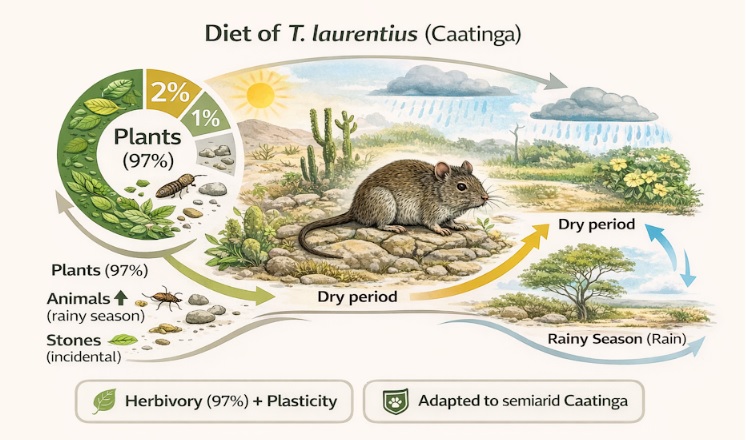
This study investigated the diet of the endemic rodent Thrichomys laurentius Thomas, 1904 in a preserved fragment of the Caatinga in the municipality of Upanema, Rio Grande do Norte, Brazil. The research was based on fecal content analysis obtained from four monthly samplings across different climatic seasons. Food items were classified and quantified using the index of alimentary importance. The results showed a predominance of plant material
(97.03%), followed by animal fragments (1.25%) and mineral particles (1.72%). Spearman’s correlation revealed a negative association between plant consumption and increased rainfall, while the intake of animal items increased during the rainy season. The presence of stone fragments appears to be related to accidental ingestion. The dietary composition of T. laurentius demonstrated seasonal flexibility and a preference for plant items, suggesting ecological adaptations to semiarid dynamics. These findings provide novel data on the species’ feeding ecology and offer valuable support for conservation strategies.
Referências
ABAYOMI, T. A. et al. Estudo histológico comparativo da língua de rato (Rattus norvegicus), morcego (Eidolon helvum) e pangolim (Manis tricuspis). International Journal of Morphology, v. 27, n. 4, p. 1111-1119, 2009.
ADEMOLA, O. J. et al. Dietary composition of rodents across different habitats in the Ukaguru Mountains, Tanzania. African Journal of Ecology, v. 60, n. 4, p. 958-968, 2022.
ANDRADE-PONCE, G. et al. Registros de mamíferos terrestres en un salado natural del Resguardo Indígena Nonuya-Villazul departamento del Amazonas, Colombia. Mammalogy Notes, v. 6, n. 1, p. e0107, 2020.
ARREGOITIA, L. D. V.; D’ELÍA, G. Classifying rodent diets for comparative research. Mammal Review, v. 51, n. 1, p. 51-65, 2021.
BASTOS, R. F.; MIRANDA, S. F.; GARCIA, A. M. Diet and feeding strategy of Characidium rachovii (Characiformes, Crenuchidae) in coastal plain streams of southern Brazil. Iheringia. Série Zoologia, v. 103, n. 4, p. 335-341, 2013.
CARVALHAES, J. G. et al. Variation in the skull morphometry of four taxonomic units of Thrichomys (Rodentia: Echimyidae), from different Neotropical biomes. Journal of Morphology, v. 280, n. 3, p. 436-445, 2019.
CASTLE, S. T. et al. Diet composition analysis provides new management insights for a highly specialized endangered small mammal. PloS One, v. 15, n. 10, p. e0240136, 2020.
CONCEIÇÃO, A. M.; BOCCHIGLIERI, A. Temporal variation in the diet of the endemic and threatened rodent Kerodon rupestris in the semiarid area of Brazil. Mammalia, v. 85, n. 6, p. 537-540, 2021.
CORREA-CÁRDENAS, Camilo A. et al. Distribution, treatment outcome and genetic diversity of Leishmania species in military personnel from Colombia with cutaneous leishmaniasis. BMC Infectious Diseases, v. 20, n. 1, p. 1-11, 2020.
COSTA-PINTO, A. L.; BOVENDORP, R. S.; PALMA, A. R. T. Coexistence in scarcity: Small mammals and seasonality in the Caatinga. Journal of Arid Environments, v. 210, p. 104908, 2023.
EMPARN - Empresa de Pesquisa Agropecuária do Rio Grande do Norte. 2023. Relatório Pluviométrico. Available at: https://meteorologia.emparn.rn.gov.br/relatorios/relatorios-pluviometricos?tipo=acumuladaCorrente. Accessed on: 02 July 2025.
FERNANDES, M. F. et al. The origins and historical assembly of the Brazilian Caatinga seasonally dry tropical forests. Frontiers in Ecology and Evolution, v. 10, p. e723286, 2022.
FINOTTI, R. et al. Diferenciação dos hábitos alimentares de três espécies do gênero Thrichomys (Rodentia, Echimyidae) através de experimento de preferência alimentar em laboratório. Boletim da Sociedade Brasileira de Mastozoologia, v. 74, p. 95-102, 2015.
FRYE, F. L. Nutritional considerations. 1995. In: Health and welfare of captive reptiles. Dordrecht: Springer Netherlands, pp. 82-97.
HANNIBAL, Wellington et al. Use of understory for frugivory by Thrichomys fosteri (Rodentia, Echimyidae). Oecologia Australis, v. 23, n. 4, p. 1100-1103, 2019.
HARMANGE, C. et al. The pivotal role of land cover around forest fragments for small‐mammal communities in a Neotropical savanna. Conservation Science and Practice, v. 5, n. 9, p. e13005, 2023.
IUCN - International Union for Conservation of Nature. 2023. Thrichomys laurentius Thomas, 1904. Available at: https://www.iucnredlist.org/search?query=Thrichomys%20laurentius%20&searchType=species. Accessed on: 02 July 2025.
KAWAKAMI, E.; VAZZOLER, G. Método gráfico e estimativa de índice alimentar aplicado no estudo de alimentação de peixes. Boletim do Instituto Oceanográfico, v. 29, n. 2, p. 205-207, 1980.
KLURE, D. M.; CRAGUN, B. J.; DEARING, M. Denise. Sympatric rodents in a desert shrubland differ in arthropod consumption. Journal of Arid Environments, v. 214, p. 104999, 2023.
LEITE, R. M. C. et al. Uso biofertilizantes para intensificação sustentável da produção de palma forrageira irrigada e uso indicadores agrometeorológicos para avaliação. Revista Brasileira de Geografia Física, v. 1, n. 1, p. 4181-4201, 2022.
LESSA, L. G.; COSTA, F. N. Food habits and seed dispersal by Thrichomys apereoides (Rodentia: Echimyidae) in a Brazilian Cerrado reserve. Mastozoología Neotropical, v. 16, n. 2, p. 459-463, 2009.
MALAQUIAS, E. C. Dieta de pequenos mamíferos em áreas de restinga no Leste sergipano. 2018. 25p. Monografia (Ciências Biológicas) - Centro de Ciências Biológicas e da Saúde, Universidade Federal de Sergipe, São Cristóvão, Sergipe, 2018.
MIRANDA, R. A.; OLIVEIRA, J. C. D.; CAMACHO, R. G. V. Análise fitofisionômica de duas áreas de floresta tropical sazonalmente seca. Geosul, v. 37, n. 81, p. 360-380, 2022.
NEVES, A. C. S. A.; PESSOA, L. M. Morphological distinction of species of Thrichomys (Rodentia: Echimyidae) through ontogeny of cranial and dental characters. Zootaxa, v. 2804, n. 1, p. 15-24, 2011.
NEWELL, F. L.; AUSPREY, I. J.; ROBINSON, S. K. Wet and dry extremes reduce arthropod biomass independently of leaf phenology in the wet tropics. Global Change Biology, v. 29, n. 2, p. 308-323, 2023.
OLALLA‐TÁRRAGA, M. Á. et al. Contrasting evidence of phylogenetic trophic niche conservatism in mammals worldwide. Journal of Biogeography, v. 44, n. 1, p. 99-110, 2017.
PAIXÃO, V. H. F. et al. Cactus height increases the modularity of a plant–frugivore network in the Caatinga dry forest. Biotropica, v. 55, n. 4, p. 877-887, 2023.
PINEDA-MUNOZ, S.; ALROY, J. Dietary characterization of terrestrial mammals. Proceedings of the Royal Society B: Biological Sciences, v. 281, n. 1789, p. 20141173, 2014.
ROMAN-PALACIOS, C.; SCHOLL, J. P.; WIENS, J. J. Evolution of diet across the animal tree of life. Evolution letters, v. 3, n. 4, p. 339-347, 2019.
SANTOS, A. R. M. et al. Valor nutritivo de plantas forrageiras cultivadas no semiárido brasileiro: Uma revisão. Revista Brasileira de Geografia Física, v. 16, n. 3, p. 1466-1489, 2023.
SENA, V. G.; LESSA, L. G. Variação sazonal na dieta de Trinomys albispinus (Rodentia, Echimyidae) em uma área de campos rupestres, no sudeste do Brasil. Oecologia Australis, v. 24, n. 3, p. 635-643, 2020.
SOARES, H. B. et al. Modelos para o ensino do exame da cavidade oral em roedores e coelhos. Archives of Veterinary Science, v. 23, n. 4, p. 17-26, 2018.
Downloads
Publicado
Como Citar
Edição
Seção
Licença
Copyright (c) 2026 Lucas De Melo Andrade, Jônnata Fernandes de Oliveira, Jean Carlos Dantas de Oliveira, Danielle Peretti

Este trabalho está licenciado sob uma licença Creative Commons Attribution-NonCommercial-ShareAlike 4.0 International License.
Os autores que publicam na Revista Conexões: Ciência e Tecnologia concordam com os seguintes termos: Autores mantêm os direitos autorais e concedem à revista o direito de primeira publicação, com o trabalho licenciado sob uma licença Creative Commons Atribuição-NãoComercial-CompartilhaIgual 4.0 Internacional (CC BY -NC-SA 4.0) . Nossos artigos estão disponíveis gratuitamente e gratuitamente, com privilégios para atividades educacionais, pesqueiras e não comerciais.


